
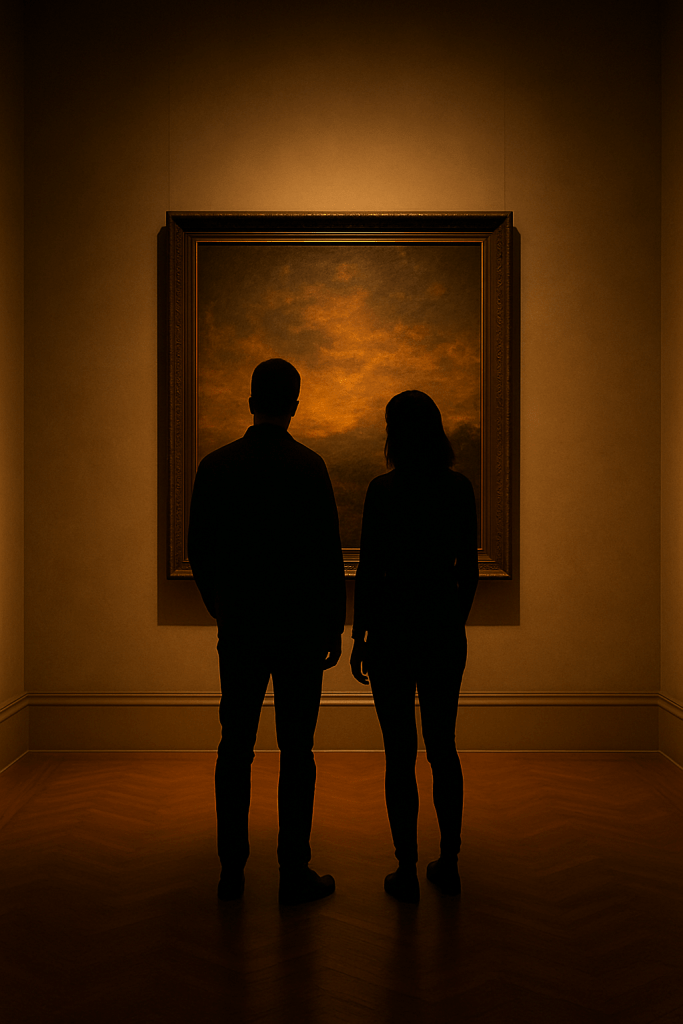
The art museum had smelled faintly of old wood and lemon polish that day — quiet enough that their footsteps echoed, loud enough that their laughter felt like rebellion. Sydney remembered walking beside Ryan, shoulder brushing shoulder, both trying to look sophisticated and failing miserably every time they passed something bizarre.
Ryan had stood in front of a modern piece — a single red line slashed across a white canvas — squinting as if decoding it.
“It’s called Screaming Into the Void,” he read.
Sydney tilted her head dramatically. “Is the void expensive? Because I think one of my students could’ve done that.”
He barked a laugh — full, unguarded, joy straight from the lungs — and it startled her how instantly she loved that sound. They wandered for hours, leaning close to whisper snark, pausing when a piece genuinely moved them, sharing both reverence and sarcasm like two sides of the same coin.
By lunch, they were sunk into a booth at a little pub nearby, the kind with sticky tables and surprisingly good sandwiches. Sunlight streamed across his face as he watched her talk — really watched — and she felt seen in a way she hadn’t in years.
He toyed with his glass, eyes on her mouth rather than the drink.
“I should tell you something,” he said, voice slower, more thoughtful.
She froze — worried, hopeful — she couldn’t tell which.
“I’m probably going to try to kiss you after this date,” he continued, eyes flicking up to meet hers. “I’ve been thinking about it since the museum.”
Her stomach flipped. Heat curled low and warm.
“You sound very sure of yourself,” she teased, trying not to grin too hard.
He smiled — not cocky, but honest. A little shy.
“Not sure,” he said softly. “Just drawn.”
But when the date ended — when he walked her to her car and hugged her, his breath ghosting near her cheek — he didn’t kiss her.
She remembered wanting him to.
She remembered wondering why he held back.
It would be months later, tangled in sheets and trust, when he finally admitted it:
“You intimidated the hell out of me.
You were different. The kind you don’t risk rushing.”
She hadn’t forgotten the way he said it — awe wrapped in hunger.
The memory faded like candle smoke as she carried a basket of laundry into the living room. The house felt too quiet, yet somehow too loud — the hum of routine, the scrape of emotional distance. Her husband sat on the couch scrolling through his phone, barely looking up when she walked in.
“Did you ever schedule the plumber appointment?” he asked, not greeting, just expecting.
“I reminded you twice,” she said, setting clothes down. “I thought you were handling it.”
He exhaled sharply — annoyed, inconvenienced.
“You could’ve just done it. I worked all day.”
“So did I,” she replied, calm but tired.
His eyes snapped up, sharp. “Yeah, but you’re home. You could’ve fit it in.”
Home.
As if home wasn’t work.
As if she didn’t bend herself to exhaustion every single day.
Sydney swallowed, throat tight. “I keep everything running here. The kids, the meals, school drop-off, pickups, laundry, bills—”
He cut in, voice clipped. “Are you trying to say I don’t do anything?”
She wasn’t.
But he wanted a fight, or maybe he just needed to win something.
She stood there staring at the man who used to feel like partner, not judge, and wondered when she stopped being chosen and started being expected.
He returned to his phone.
Argument dismissed.
Her feelings an afterthought.
For a moment — one dangerous, private moment — she wished she were back in the museum with Ryan, laughing at things that didn’t matter, feeling wanted without asking for it.
She picked up a tiny sock, held it like a fragile truth.
She missed being looked at the way Ryan once looked at her artfully lit in a museum hallway — like she was something worth pausing for.
Like she was art.
 Her Quiet Escape